



London-based biomaterials startup Planet Smart has raised $1 million in pre-seed funding to bring its first product, PlanetSorb, to market. The round was led by General Inception and Vertical Venture Partners, with support from Innovate UK and the Undaunted Accelerator.
PlanetSorb is positioned as the first biodegradable superabsorbent polymer (SAP) that naturally breaks down in under six months without generating microplastics. It also surpasses traditional fossil-based SAPs in performance, absorbing more than one litre of liquid per gram, up to twice the efficiency of existing materials.
We’ve shown that sustainability doesn’t have to mean sacrifice. Our material is greener, faster, and built to scale, and it simply disappears when its job is done
Dr. Gerald Marin – CEO and cofounder
The startup’s origins trace back to a river clean-up in the Philippines, where Marin witnessed the scale of plastic waste caused by disposable nappies. He and cofounder Maurice Rüttimann, shifted from NGO work to scientific innovation, ultimately building Planet Smart at the White City innovation hub. The team now includes polymer chemists and former executives from BASF and P&G Ventures.
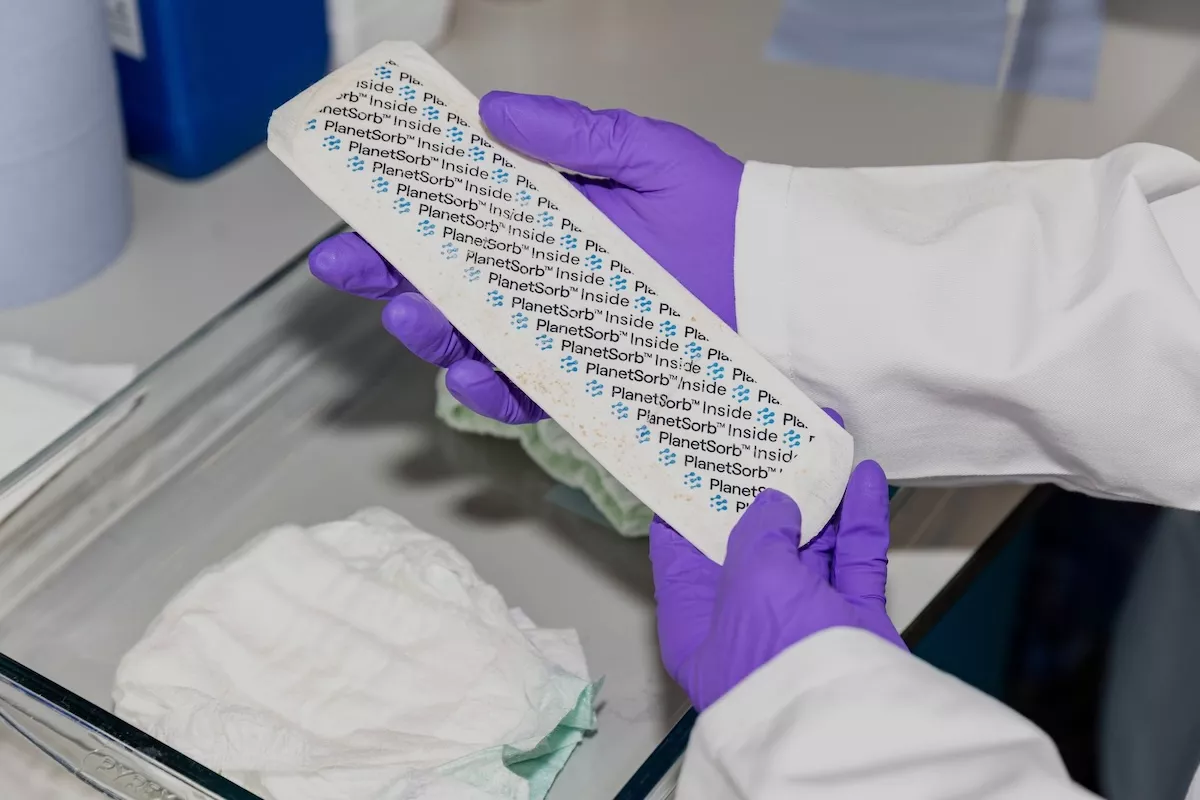
Planet Smart’s poly-amino-acid-based polymer degrades naturally in soil or landfill
The hygiene sector discards an estimated 500,000 disposable nappies and pads every minute, and regulatory pressure is intensifying. The EU ban on intentionally added microplastics and upcoming deforestation-related regulations are pushing manufacturers to seek scalable biodegradable materials.

Planet Smart’s poly-amino-acid-based polymer degrades naturally in soil or landfill, offering what the founders call a “commercially pragmatic” alternative. The company has already secured three letters of intent from major hygiene manufacturers and two purchase ordersfrom European brands.
Third-party testing has confirmed that PlanetSorb is non-toxic, dermatologist-approved, and achieves industry-leading absorbency and retention. Beyond hygiene, the biodegradable absorbent technology could extend into agriculture, wound care, food packaging, and mining waste management.
Planet Smart aims to scale to one kilotonne of production capacity by 2028, equivalent to roughly 45 million nappies’ worth of PlanetSorb. A larger fundraising round is planned for 2026 to expand manufacturing and develop licensing partnerships with global FMCG players.